How to Create WhatsApp Marketing Campaigns That Actually Convert [2026 Guide]
Did you know that WhatsApp marketing campaigns achieve open rates of nearly 98%, with most messages read within minutes?
Compared to email campaigns that struggle to reach open rates of 15–25%, WhatsApp cuts through digital noise with remarkable precision. With more than 2.78 billion unique active users in 2024 and forecasts projecting growth beyond 3.2 billion in 2025, WhatsApp has established itself as the world’s most popular messaging app.
The numbers tell a compelling story. Every day, 175 million users send messages to WhatsApp Business accounts, while the WhatsApp Business Platform drives 89% higher purchases per user. Additionally, 65% of consumers prefer using messaging apps to interact with businesses.
This is not just another marketing channel—it has become a powerful component of modern eCommerce infrastructure. WhatsApp lead generation works fast, enabling you to connect with customers quickly, reduce response times, and ultimately convert more prospects.
Messages appear directly on customers’ lock screens, feel personal, and are typically read within minutes—making WhatsApp a natural choice for businesses looking to connect meaningfully with their audience. In parts of Latin America, where WhatsApp messaging is more popular than email and social media combined, these campaigns have proven to be especially effective.
In this article, you’ll learn exactly how to create WhatsApp marketing campaigns that drive real results in 2026—from setting up your business account to launching campaigns that actually convert.
Why WhatsApp Marketing Works in 2026
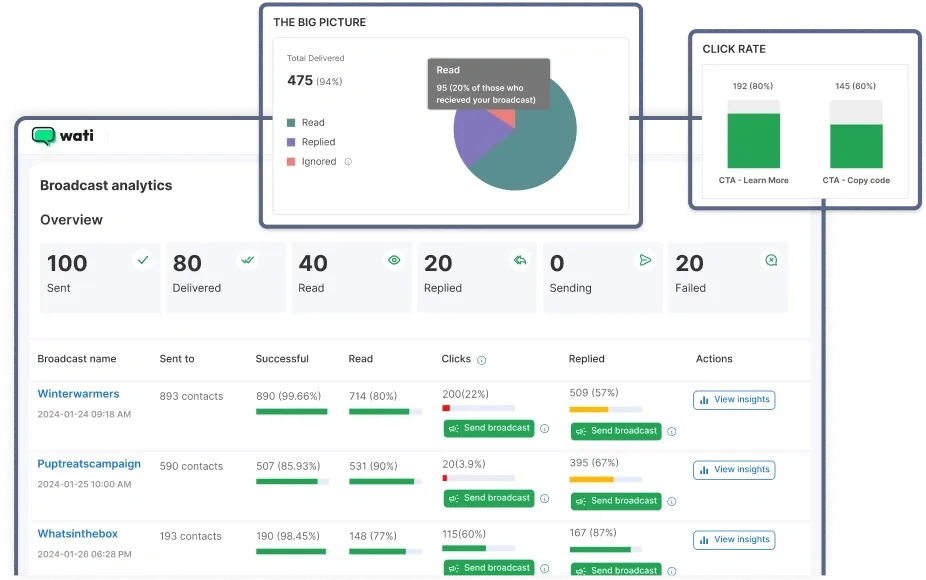
Image Source: Wati
Why WhatsApp Marketing Works in 2026
The numbers behind WhatsApp marketing effectiveness are striking—especially when you look at why businesses continue to adopt this channel in 2026.
High Open and Response Rates
What truly sets WhatsApp marketing campaigns apart is their exceptional visibility. WhatsApp messages achieve open rates of 90–98%, dramatically outperforming the modest 15–25% average for email. This fundamental advantage ensures your messages actually reach your audience.
Beyond visibility, WhatsApp drives action. Campaigns routinely generate click-through rates above 50%, creating a massive advantage over the typical 1–4% CTR of email. Additionally, WhatsApp response rates exceed 55%, nearly double the 28% achieved by SMS campaigns.
Messages aren’t just opened—they’re opened fast. Unlike email, which may sit unread for hours or days, WhatsApp communications are typically seen within minutes of delivery. This immediacy turns time-sensitive offers from missed opportunities into revenue generators.
Direct and Personal Communication
WhatsApp fundamentally shifts marketing from broadcasting messages to facilitating conversations. The platform enables genuine two-way communication rather than one-sided promotions. This conversational nature helps resolve customer questions in real time and gently guide prospects toward purchase decisions.
Think of it as having a virtual store assistant available 24/7. Customers can ask questions, receive personalized recommendations, or resolve issues instantly—without ever leaving the app. This direct interaction builds trust and fosters stronger customer relationships.
Mobile-First User Behavior
WhatsApp is deeply embedded in daily life. Users check messages multiple times per hour and respond instantly—it’s woven into their routine, with average daily usage often exceeding 30 minutes.
This persistent engagement explains why WhatsApp dominates messaging across major markets. Throughout Latin America, Europe, and large parts of Asia, WhatsApp remains the primary messaging channel of choice. For marketers, this widespread adoption translates into a critical advantage: higher visibility and faster action in the same inbox users already trust.
Comparison with Email and Social Media
When evaluating marketing channels in 2026, WhatsApp offers distinct advantages that explain its growing prominence:
- No spam folder competition: Messages land directly in the customer’s main inbox without algorithmic filtering or promotional tabs.
- Richer media capabilities: WhatsApp supports images, videos, product cards, PDFs, and clickable buttons for seamless interaction.
- Unmatched urgency: Few things drive immediate action like a message delivered straight to a user’s most-used app.
That said, email still has its strengths. It remains more cost-effective at scale, as WhatsApp typically charges per message or conversation, while email often operates on flat monthly subscriptions regardless of volume.
The most effective marketing strategies in 2026 don’t force a choice between channels. Instead, successful businesses strategically integrate WhatsApp, email, and other touchpoints—leveraging each for its unique strengths across the customer journey.
Setting Up Your WhatsApp Marketing Campaign
Before you start sending messages to customers, laying the right foundation for your WhatsApp marketing campaign is essential. A properly configured account not only ensures compliance but also maximizes conversion potential.
Create a WhatsApp Business Account
First, you’ll need a Meta Business Account and access to the WhatsApp Business Platform. Start by visiting Meta Business and clicking “Create an Account.” Select your Facebook Page, provide your company details, and complete the onboarding process.
Next, go to Facebook Business Manager → Business Settings → WhatsApp Accounts, then click Add → Create a WhatsApp Account. Fill in the required details, including account name, messaging purpose, time zone, and currency. Finally, assign team members with the appropriate permission levels.
For small businesses, the WhatsApp Business app offers a simpler alternative. Download it from Google Play or the Apple App Store, verify your phone number, and complete your profile with your business name, category, logo, description, address, website, and business hours.
Collect Customer Opt-Ins the Right Way
Before sending any marketing messages, obtaining explicit customer consent is mandatory. This opt-in requirement isn’t just a legal obligation—it’s essential for building trust and avoiding spam complaints.
There are four effective ways to collect WhatsApp opt-ins:
- Website integration: Add opt-in prompts on high-traffic pages using pop-ups, banners, and chat widgets. Include clear checkboxes in forms with statements like “Send me updates via WhatsApp from [Brand].”
- At checkout: Offer order updates, delivery notifications, or receipts via WhatsApp at the point of purchase.
- Customer support: Invite customers to opt in after resolving their inquiries.
- QR codes and links: Place WhatsApp QR codes on your homepage, product pages, and help center.
Always clearly state your business name and the type of messages customers will receive. Make opting out simple and accessible at any time.
Segment Your Audience for Better Targeting
Effective WhatsApp marketing depends on sending relevant messages to the right people. Segmentation divides your contacts into meaningful groups based on shared characteristics.
Consider these segmentation approaches:
- Behavioral segmentation: Group users based on purchase history, engagement levels, and responsiveness to previous messages.
- Demographic segmentation: Categorize by age, gender, location, and occupation.
- Customer journey stage: Tailor messages based on whether contacts are new leads, first-time buyers, or repeat customers.
Segmentation reduces spam complaints, builds trust, and ultimately leads to higher engagement and stronger conversions.
Choose the Right Campaign Objective
Every WhatsApp marketing campaign should have clear goals. Common objectives include lead generation, nurturing prospects during the consideration stage, or providing post-purchase support.
Once you’ve defined your campaign goals and audience, you can select appropriate entry points and content types. Throughout the campaign, track metrics aligned with your objectives—such as reach, qualified leads, conversion rates, and ROI.
For growing businesses, focus on metrics that demonstrate tangible value: conversion rates, cost per qualified lead, and total revenue generated from your WhatsApp initiatives.
8 WhatsApp Campaign Types That Actually Convert
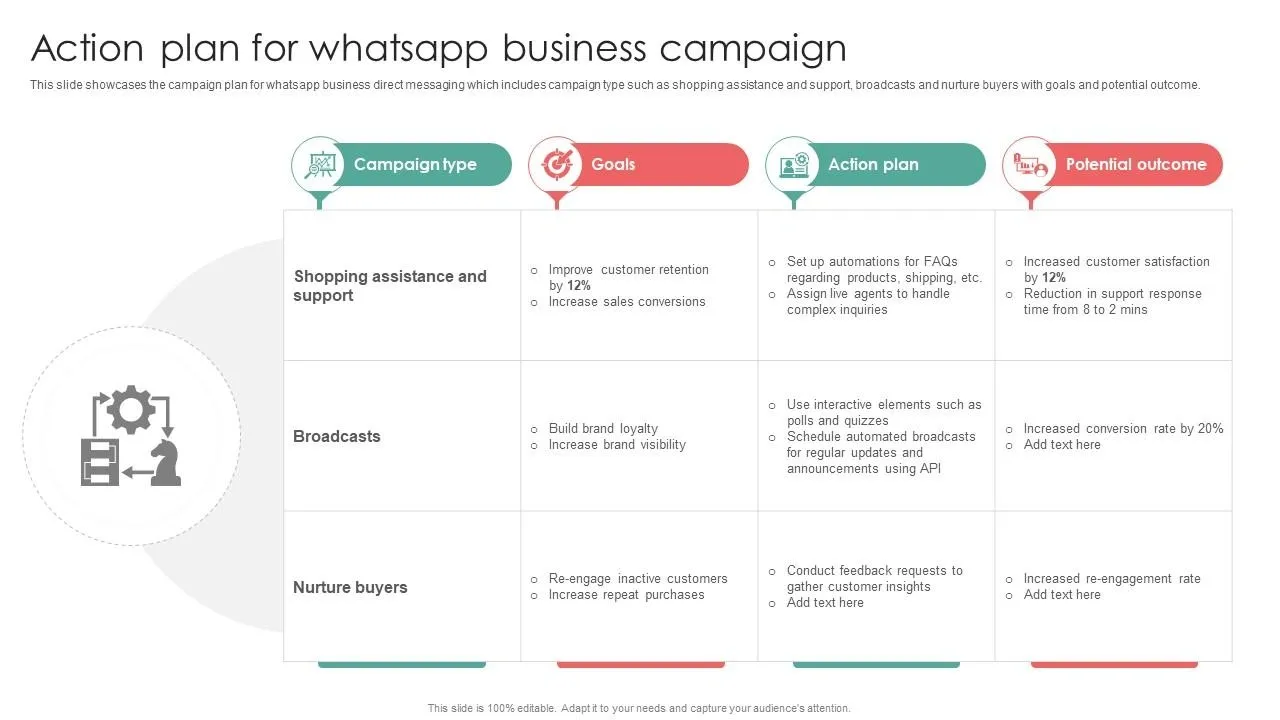
Image Source: SlideTeam
Once you’ve established your WhatsApp foundation, it’s time to explore specific campaign types that deliver real results. These eight proven WhatsApp marketing approaches consistently drive higher engagement and conversions.
1. Abandoned Cart Reminders
Cart abandonment affects eCommerce heavily, with approximately 70% of online shopping carts left incomplete. WhatsApp dramatically outperforms email for recovery thanks to its immediate visibility. By sending personalized reminders that include product images and direct checkout links, you can efficiently recover lost revenue. Fashion retailer Lojas Renner achieved read rates 70% higher than other channels, significantly increasing completed purchases.
2. Product Launch Announcements
Product launches via WhatsApp generate 3x higher conversion rates compared to email. This approach turns generic announcements into personalized conversations with 90%+ open rates. For maximum impact, build excitement with early-access offers for subscribers. Send previews to VIP customers first, follow with general announcements, then maintain momentum with testimonials on day two.
3. Flash Sales and Limited-Time Offers
Urgency drives action. Flash sales and limited-time offers create FOMO (Fear of Missing Out), compelling customers to make quick decisions. Effective WhatsApp flash sale messages include:
- Personalized greetings using customer names
- Clear, time-bound offers (e.g., “Ends at midnight”)
- Step-by-step redemption instructions
- One-tap “Buy Now” buttons
4. Post-Purchase Follow-Ups
Post-purchase experiences significantly impact loyalty, with 67% of customers making repeat purchases after positive follow-ups. Immediate order confirmations, shipping updates, and delivery notifications keep customers informed and reduce support inquiries. These timely communications make customers feel valued, turning one-time purchases into ongoing relationships.
5. Loyalty and VIP Messages
WhatsApp has become a powerful loyalty bridge, with coupon redemption rates reaching 87%. Instead of passive loyalty programs, proactively engage members with personalized replenishment reminders, exclusive early access to new products, and VIP-only offers. This approach transforms a loyalty database into an active journey where customers feel recognized and rewarded through their preferred messaging channel.
6. Customer Support and Service Flows
Customer support via WhatsApp achieves satisfaction rates of up to 90%. Build structured flows that provide quick answers to common questions while maintaining a clear path to human agents when needed. Include options to track orders, get product help, or schedule appointments—without customers ever leaving the app they already use daily.
7. Feedback Requests and Surveys
WhatsApp surveys generate significantly higher response rates than traditional methods due to their convenience and immediacy. Keep surveys conversational by presenting one question at a time rather than overwhelming customers with long forms. Use rich features like response buttons and list messages to make replying effortless.
8. Re-Engagement and Win-Back Campaigns
Win-back campaigns target customers showing signs of inactivity—such as no purchases in 60–90 days or declining message engagement. These automated, behavior-triggered conversations can reactivate up to 35% of inactive customers. Successful reactivation isn’t about generic “we miss you” messages, but about delivering contextual value based on previous interactions and purchase history.
Personalization and Automation Tactics
Effective WhatsApp marketing campaigns rely heavily on personalization and automation to deliver timely, relevant messages without overwhelming your team. Recent data shows that personalized WhatsApp messages achieve significantly higher engagement, leading to improved conversion outcomes.
Use Customer Data to Personalize Messages
Collect first-party data through forms, surveys, and interactive conversations, alongside data from your online store and marketing channels. This combination creates rich customer profiles that allow segmentation based on purchase history, browsing behavior, and engagement levels. For example, a customer who regularly buys skincare products can receive alerts about newly launched serums that complement their existing routine.
Automate Flows with Tools Like Hellotext
Tools such as Hellotext integrate WhatsApp with platforms like Shopify, WooCommerce, and Wix, enabling fully automated customer engagement campaigns. These platforms save time, reduce manual work, and improve conversion rates by managing conversations from a single interface. In practice, businesses report streamlined communication and measurable sales results from automation tools.
Trigger Messages Based on User Behavior
Set predefined triggers that automatically send WhatsApp messages based on specific customer actions or inactivity. Common behavioral triggers include:
- Cart abandonment (after one hour of inactivity)
- Product page views
- Post-purchase follow-ups
- Re-engagement for inactive customers
These event-based triggers ensure the right message reaches customers at the right moment.
Add Dynamic Variables Like Name or Product
Personalize message templates using dynamic fields that automatically insert customized information. Variables such as customer names, browsing history, order details, and product recommendations transform generic messages into personalized communications. For example:
“Hi [Name], we noticed you love [product category]. Here’s a special offer just for you!”
This type of message consistently outperforms generic broadcasts.
Measuring and Optimizing Campaign Performance
Tracking the success of your WhatsApp marketing campaigns doesn’t have to be complicated. Measuring the right metrics helps you understand what works—and what needs improvement.
Track Open, Click, and Conversion Rates
Start by monitoring your open rate, which helps assess engagement and optimal sending times. Track your click-through rate to see how often users interact with links. Most importantly, measure your conversion rate, along with revenue generated versus spend. These metrics directly define your campaign ROI.
WhatsApp provides built-in analytics through the Business API, making it easy to access these insights without additional tools.
Run A/B Tests on Message Formats
Implement structured A/B testing by changing only one variable at a time—CTA text, media usage, or message tone. Proper A/B testing can increase response rates by 20–30%. Ensure test audiences are large enough (at least 200 recipients per variant) for statistically valid results.
Start by testing message timing, then move to content variations once optimal sending windows are established.
Adjust Timing and Frequency
When should you send messages? Timing optimization can boost engagement by up to 40% and conversions by 25%. Establish quarterly optimization cycles to review timing strategies based on accumulated data.
Test different days and times to uncover patterns specific to your audience—often very different from general industry benchmarks.
Use Insights to Refine Future Campaigns
Go beyond surface metrics and identify what truly resonates with your audience. This insight-driven approach reduces message costs by focusing on high-performing templates, increasing overall WhatsApp marketing ROI.
If certain message types consistently outperform others, turn them into reusable templates. Over time, you’ll build a library of proven message formats that can be adapted across campaigns.
Conclusion
WhatsApp marketing has established itself as a powerful conversion channel thanks to its exceptional 98% open rates and immediate visibility. Throughout this guide, we’ve explored why WhatsApp outperforms traditional channels and how you can implement it effectively in your 2026 marketing strategy.
The data speaks clearly. WhatsApp’s direct, personal communication style creates unmatched engagement opportunities compared to email or social media. Combined with mobile-first user behavior, your messages receive immediate attention and action.
Proper setup forms the foundation of success. Creating a business account, collecting opt-ins correctly, segmenting your audience, and defining clear campaign objectives must come before any messaging efforts.
The eight campaign types discussed—from abandoned cart reminders to re-engagement flows—provide a complete toolkit for different marketing goals. Each targets specific stages of the customer journey and behavioral triggers, maximizing conversion potential.
Personalization and automation work together as essential components of successful WhatsApp marketing. Using customer data to tailor messages while implementing behavior-based automated flows significantly improves engagement and conversion rates.
Campaign performance requires constant monitoring and refinement. Tracking key metrics, running A/B tests, and adjusting timing based on insights will continuously improve results and ROI.
WhatsApp marketing demands thoughtful implementation, but its rewards far outweigh the initial setup effort. As customers increasingly prefer messaging apps for brand interactions, mastering this channel provides a major competitive advantage.
Start small, test often, and analyze deeply. If you have any questions about implementation, our team will be happy to help you maximize conversions through this powerful communication channel.
Key Takeaways
WhatsApp marketing delivers exceptional results with 98% open rates and immediate customer engagement. Key strategies for campaigns that convert:
- WhatsApp dominates engagement metrics with 90–98% open rates and 50%+ click-through rates
- Proper setup drives success through opt-ins, segmentation, and clear objectives
- Eight proven campaign types consistently convert across the customer journey
- Personalization and automation maximize ROI using behavioral triggers and dynamic data
- Continuous optimization through A/B testing and performance tracking is essential
WhatsApp’s conversational nature transforms marketing from broadcasting into meaningful dialogue. With 2.78 billion active users preferring messaging apps for brand interactions, mastering this channel is a major advantage in 2026’s mobile-first landscape.
FAQs
Q1. What makes WhatsApp marketing more effective than email?
WhatsApp achieves much higher open rates (90–98% vs. 15–25%), messages are read within minutes, and CTRs often exceed 50%. Its conversational nature also enables real-time interaction.
Q2. How do I set up WhatsApp marketing for my business?
Create a WhatsApp Business account, obtain explicit customer opt-ins, segment your audience, and define clear campaign goals before launching.
Q3. Which WhatsApp campaigns perform best?
Top-performing campaigns include abandoned cart reminders, product launches, flash sales, post-purchase follow-ups, loyalty programs, customer support flows, feedback requests, and re-engagement campaigns.
Q4. How can I personalize WhatsApp messages?
Use customer data, dynamic variables (name, product, history), and behavioral triggers to send timely, relevant messages.
Q5. What metrics should I track?
Track open rates, click-through rates, conversion rates, revenue, and ROI. Use A/B testing on timing and content to optimize performance continuously.
